

Context of the Circular Footprint Formula
With the entry into force of the Batteries Regulation (EU) 2023/1542, the carbon footprint of batteries is becoming a central criterion for access to the European market. Manufacturers must now quantify, declare and, in time, comply with greenhouse gas emission thresholds across the entire life cycle of batteries. In this context, the consideration of circularity — and in particular the recycling of critical raw materials and strategic materials such as nickel, cobalt or lithium — becomes a major methodological challenge. How should environmental impacts be allocated across multiple life cycles? How to avoid both double counting and the absence of incentives for recycling ? With the Circular Footprint Formula (CFF).
Indeed, it is to address these questions that this formula was introduced as part of the work of the European Commission, notably through the Product Environmental Footprint (PEF) method. The CFF provides a harmonised approach to modelling flows of recycled materials and recovered energy, allocating impacts between the upstream and downstream life‑cycle stages using parameters. Unlike traditional approaches such as cut‑off or avoided burden, the CFF aims to strike a balance by sharing the impacts and benefits of recycling between the different product systems.
The European carbon footprint methodology requires the use of a specific battery CFF. In this article, we aim to break down this formula and explain how manufacturers and LCA practitioners can prepare for its implementation.
A breakdown of the CFF battery
A 6-part CFF formula…
The CFF for batteries introduced in the draft delegated act (DDA) is divided into six parties, each with its own settings:
1. Materials inputs (manufacturing)
CFF mat inputs
The upstream impacts of primary materials (extraction, refining) as well as the impacts and credits related to the use of secondary materials (recycling)
2. Dismantling (End of Life, EoL)
CFF mat dis
Applies to the pre-treatment at EoL: Impacts and credits of production of secondary housing materials and copper cables
3. PWB Recycling (EoL)
CFF PWB R / AE
Applies to the production of secondary materials (Cu, Au, Ag, Pd) from the recycling of Printed Wiring Boards (PWB)
4. Cell recycling (EoL)
CFF mat R / AE
Applies to the production of secondary materials (Li, Ni, Co, Cu, Al) from cell recycling. Significant impact on credits related to recycled content
5. Energy recovery (EoL)
CFF ER
For energy recovery from incineration of plastics from properly collected battery waste
6. Disposal (EoL)
CFF disp
Waste from batteries non-properly collected and materials from properly collected batteries that are not recycled
Each part of the CFF must be applied directly to the relevant flows, as illustrated in the diagram below. For production waste (scraps), there is no dedicated formula; it depends on the real end‑of‑life treatment of the waste (incineration, recycling, etc.).
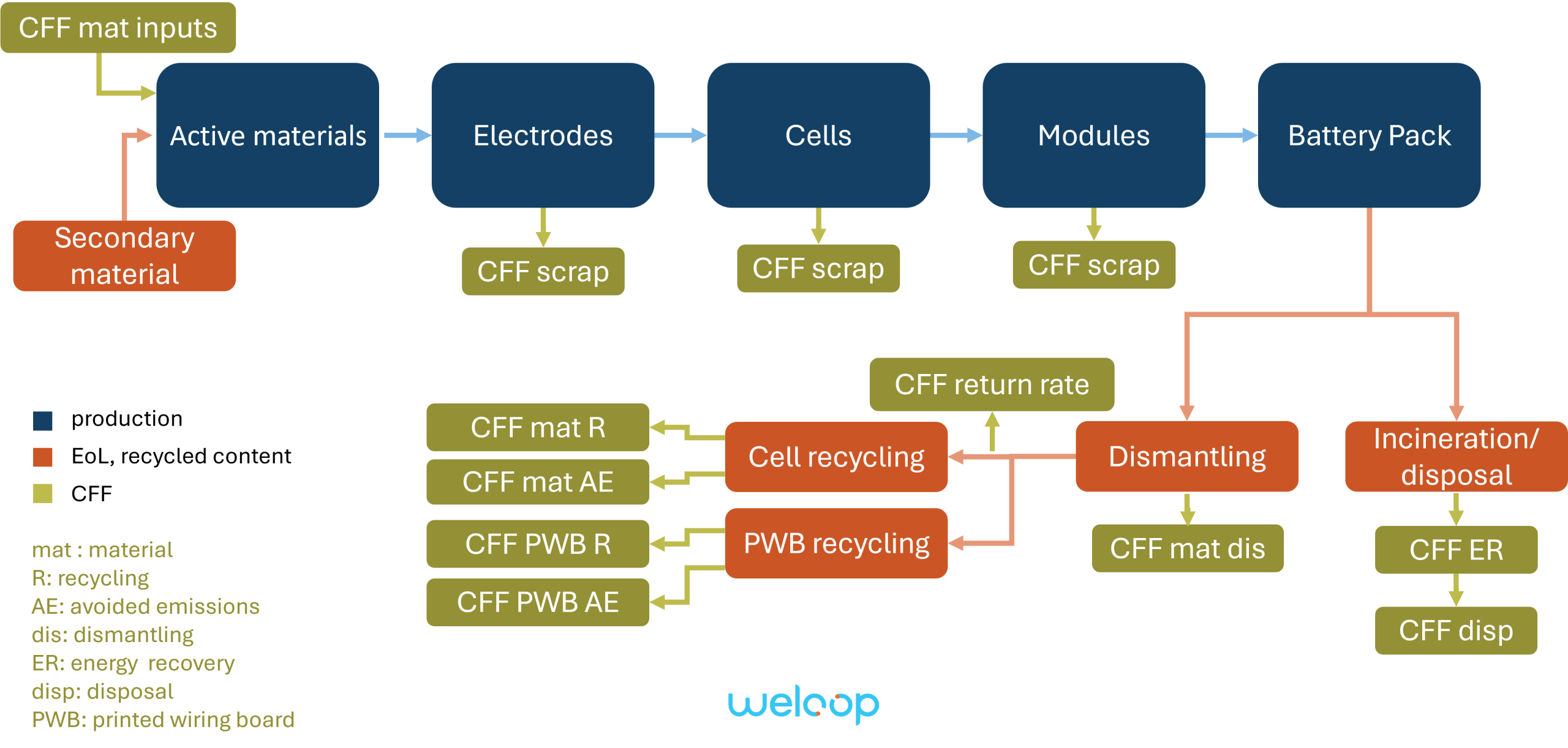
… with 3 main distinctions
This segmentation takes into account three distinctions in the application of the CFF:
These distinctions directly influence how emissions are attributed, particularly in cases where collection efficiencies and material recovery rates diverge. As a result, the CFF becomes sensitive to end‑of‑life operational performance. In practice, however, a default inventory for cell recycling and a collection‑rate parameter of 80% are imposed by the regulation, and primary data may only be used under specific conditions.
Moreover, the use of different allocation factors at the materials, cells, and electronic components levels introduces flexibility in how impacts and credits are distributed between the two life cycles, thus allowing the specifics of each value chain to be reflected. However, in practice, these allocation factors, denoted by A, are uniformly set to 0.2 by default in the DDA.
What are the practical implications of the battery CFF ?
The distinction between collection rate and recycling efficiency avoid over-crediting systems who show good recycling but insufficient collection.
While the DDA imposes a default collection rate, company-specific rates can be applied under ownership-based business models, where the manufacturer retains responsibility for the battery throughout its life cycle.
The allocation factors for material recovery from the battery cells, printed wiring boards, and battery housing are all set at 0.2 in the DDA.
This means that 80 % of recycling credits (and impacts) are attributed to recycling, while 20 % are attributed to use as recycled input.
The CFF increases data granularity requirements throughout the entire value chain, reflecting the due diligence :
- Manufacturing: share and quality of recycled material inputs
- End-of-life collection and pre-treatment: recovery routes, dismantling processes, and fate of key components
- Recycling: material-specific recovery yields and quality of secondary materials (when primary data is used for recycling)
LCA modelling complexity
The CFF introduces a new layer of modelling complexity, requiring a detailed understanding of the formula itself and its proper application in a LCA model.
How to prepare for the battery CFF?
Given the level of methodological complexity and the granularity of data required, as well as the limited implementation timeframe following the publication of the final Delegated Act, waiting for the definitive regulatory texts or the compliance deadlines could significantly increase both costs and risks.
The most effective approach is to anticipate early. This section therefore sets out best practices to be ready to calculate the regulatory battery carbon footprint when the time comes.
1. Integration of end-of-life processes and secondary materials into LCA models
Indeed, a first step consists of extend existing LCA models, focused today on manufacturing, in order to take into account end-of-life processes and secondary material flows.
This includes:
2. Parameterisation of LCA for robust, flexible, and modular LCA modelling
In order to anticipate changes in battery end‑of‑life management, in the production process or in the regulatory text, it is recommended to implement a robust parameterisation of the LCA model. This allows the model to be used as a decision‑support tool both for regulatory compliance and for internal decision‑making.
This can take the form of parameterising the:
Parametric modelling approaches offer a additional flexibility to explore scenarios going beyond regulatory compliance. Parameterised recycling models allow for the evaluation of different technologies, black mass compositions and recycling yields, thereby supporting R&D and process optimisation. In parallel, parameterised co-product allocation allows for efficient model updates in response to vMarket price variations or to methodological choices, without requiring model reconstruction.
Our support for the battery CFF application and end-of-life modelling
Our expertise in the overall functioning of battery EoL processes and in the CFF enables us to support you in your preparation for the battery CFF and carbon footprint.
You can find an example of our support in our presentation at LCM 2025
Your teams will understand the formula's parameters and know how to use it.
Your teams will understand the allocation methods and know how to choose the appropriate emissions factors for the application of the GHG protocol
We have a database of inventories of recycled materials from battery recycling for representative emission factors.