


Our BATTERS database of battery recycling inventories
You lack battery recycling inventories to assess the environmental impact of batteries incorporating recycled materials ? We have data reliable, transparent and representative industrial realities, to support your analyses and decisions!
What is the BATTERS database?
This is the database of inventories for Life Cycle Assessment (LCA) and carbon footprint, specialised in battery recycling inventories. Are you an industrial stakeholder, engineering consultancy, researcher, or decision-maker who needs LCA data specific to battery recycling? You are in the right place!
Providing detailed Life Cycle Inventory (LCI) datasets on recycling processes, the BATTERS database enables reliable quantification of the environmental footprint of batteries. Indeed, in a context of strict regulatory requirements and constrained access to critical metals, the use of recycled materials is becoming a prority.
From a regulatory perspective, for the battery carbon footprint declaration, these inventories can be used for the consideration of recycled materials incorporated into batteries. They also provide a primary alternative to the default recycling scenario defined in the delegated act, when the recycling process implemented by the recycler selected by the manufacturer corresponds to the processes in the inventories.
Why recycling inventories for lithium-ion batteries?
Critical metals and uncertainty of supply
Lithium-ion batteries contain critical and strategic metals whose future supply
is uncertain.
Mandatory recycling and quality of materials
The European regulation (EU) 2023/1542 makes battery recycling mandatory, ensuring a national/regional supply of high‑quality metals.
Environmental impact of recycled materials
To calculate the carbon footprint and other impacts, it is essential to know the recycling process that produces the recycled material.
Impact of battery recycling processes
If you are not directly involved in recycling activities, it is necessary to have inventories of recycling processes in order to calculate the impacts.
Limitations of existing
databases
Current LCA databases lack details and offer generic or non‑existent data for certain recycling processes and recycled materials.
The BATTERS database
solution
With its recycling LCI datasets for batteries and recycled metals across different technologies, the BATTERS database fills these gaps.
Why choose our BATTERS recycling LCI database?

* Analysis from January 2026
What does the BATTERS database contain?
It includes battery recycling inventories and recycled materials inventories from five processes including Black Mass preparation, hydrometallurgy and pyrometallurgy.
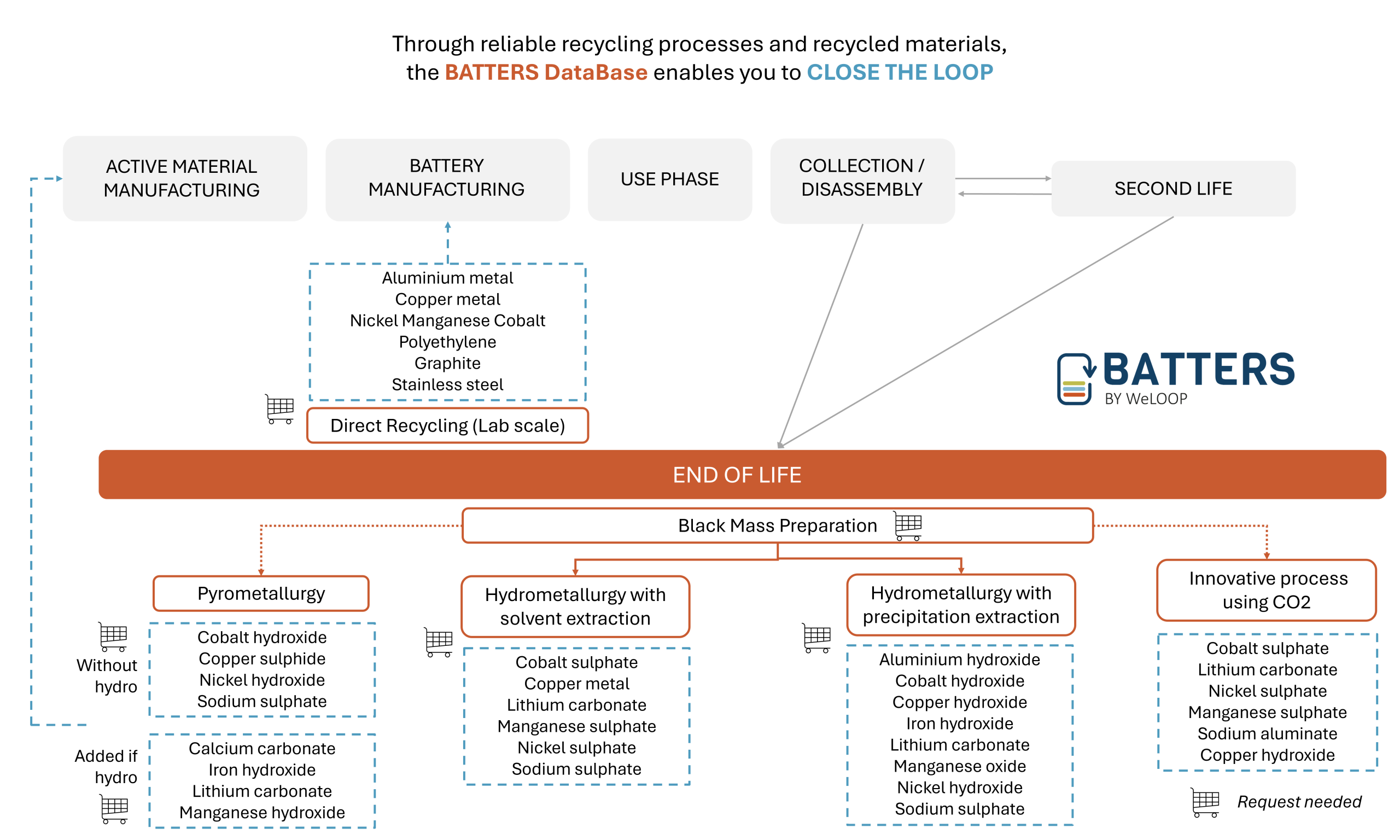
In order to enable you to use them both for industrial simulations and for research work and advanced LCAs, the LCIs are customisable according to:
What can you do with BATTERS battery recycling inventories?
Compare
different battery recycling technologies and their recycled materials
Simulate
realistic industrial scenarios to meet regulatory requirements
Reduce
the uncertainty associated with the limited data available in other databases
The plus: you will benefit from the support of an expert team, available to answer your questions
How can I obtain BATTERS recycling LCIs?
The inventories in the BATTERS database are available for purchase under different levels of detail :
The formats are compatible with the main LCA softwares : LCA for Experts, SimaPro and openLCA.
Request a quote
Ready to move to the next step?
Discover the database, request your quote or exchange ideas with our team to answer your questions.