

Batteries have become omnipresent: electric mobility, renewable energy storage, consumer electronics, and industrial applications. They are positioned as a technological pillar of the ecological transition, driven by their role in decarbonising transport and the electricity grid.
However, claiming that batteries are a «green» solution because they generate fewer emissions in use is an oversimplification that masks a far more complex reality. Indeed, the environmental impact of a battery begins long before it is put into service, and it's often there that it's most significant!
A rigorous environmental assessment should therefore consider the entire product journey, from raw material extraction to end-of-life. This is precisely what is offered byLife Cycle Assessment (LCA).
What is Life Cycle Assessment (LCA)?
Life Cycle Assessment (LCA) is an ISO 14040 and 14044 standardized method that is used to calculate the environmental impacts of a product, a process, or a service across its entire life cycle.
It is explicitly integrated in several European regulatory texts, including the new Batteries Regulation (EU 2023/1542), the Ecodesign for Sustainable Products Regulation (ESPR), and the Critical Raw Materials Act (CRMA), which demonstrates its scientific robustness and institutional recognition. LCA is therefore the reference standard for environmental declarations .
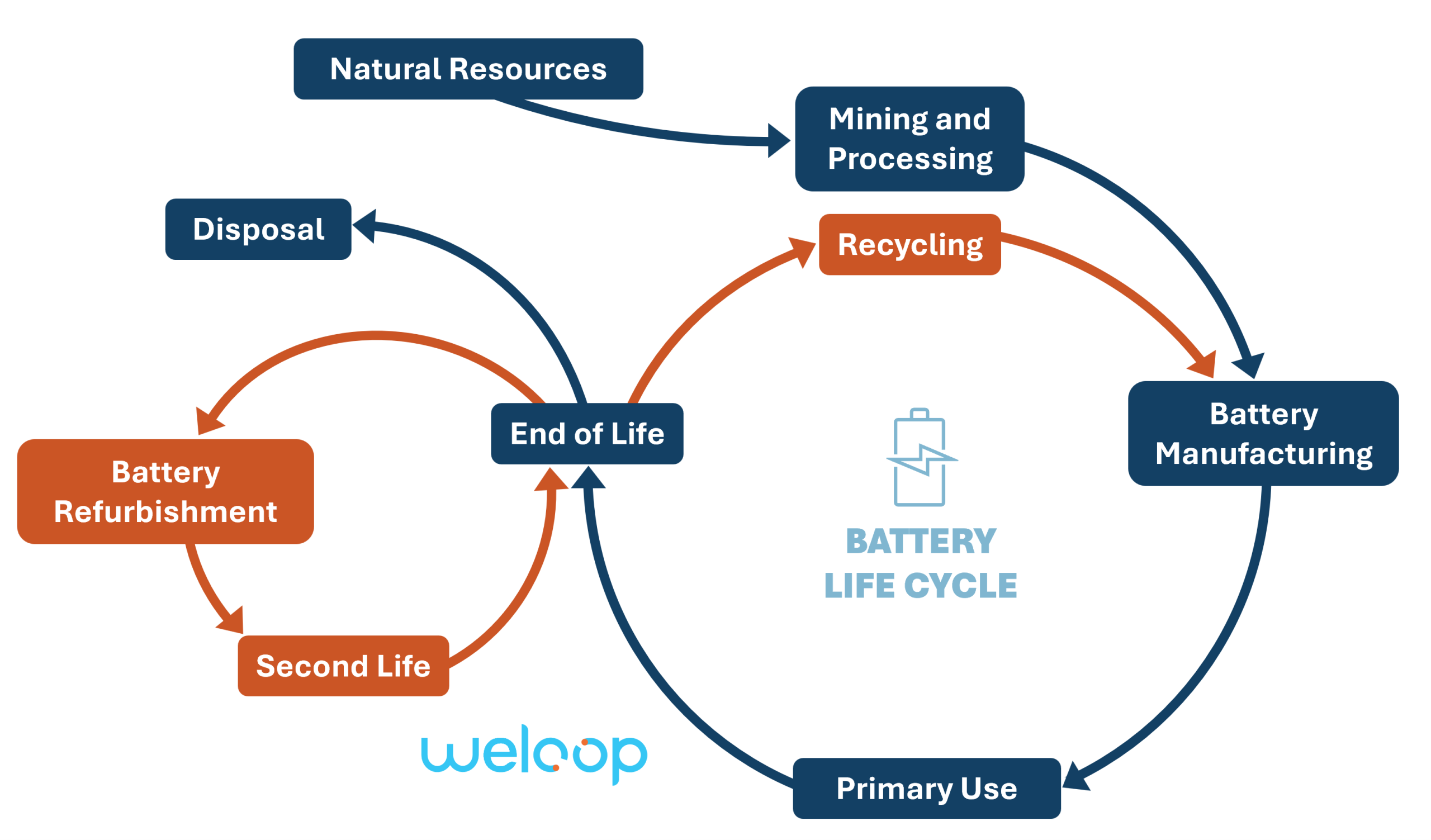
Applied to batteries, LCA provides a comprehensive view of environmental impacts, including carbon footprint, across each stage of the life cycle: raw material extraction, manufacturing, use, second life, and end-of-life (EoL).
What is a Life Cycle Assessment (LCA) used for?
LCA addresses concrete sustainability challenges within the battery sector beyond environmental reporting.
1. Identify and prioritize improvement pathways
Where does the environmental impact
of my battery really come from?
LCA allows the identification of the most contributing steps and processes for prioritising the right pathways for reduction.
Should we secure a less carbon-intensive lithium supply? Reduce energy consumption in manufacturing?
With an LCA, each process and scenario can be quantified and compared objectively.
2. Objectively compare products
How could we compare environmental
performance of two systems?
Assessing batteries based solely on their use phase, or on a single indicator such as manufacturing CO₂ emissions, may produce partial and potentially misleading conclusions.
LCA's multicriterion and multi-step approach allows the comparison of equivalent functionsacross systems, as long as the same methodological approaches are applied.
3. Credibility of environmental communication
How can we communicate our
environmental impact?
As scrutiny around greenwashing grows, greenwashingenvironmental claims must be backed by measurable, verifiable, and standardized data.
A life cycle assessment that has undergone critical review provides a robust and reliable basis for communication.
4. Meet regulatory requirements
How to respond to a client or
regulatory requirements?
Under the European Battery Regulation (EU 2023/1542) batteries on the market must have a Carbon Footprint (CF) declaration covering manufacturing and end-of-life stages.
LCA is no longer just a competitive advantage:
it is becoming a market requirement.
How are Life Cycle Assessments conducted?
An iterative 4-step approach…
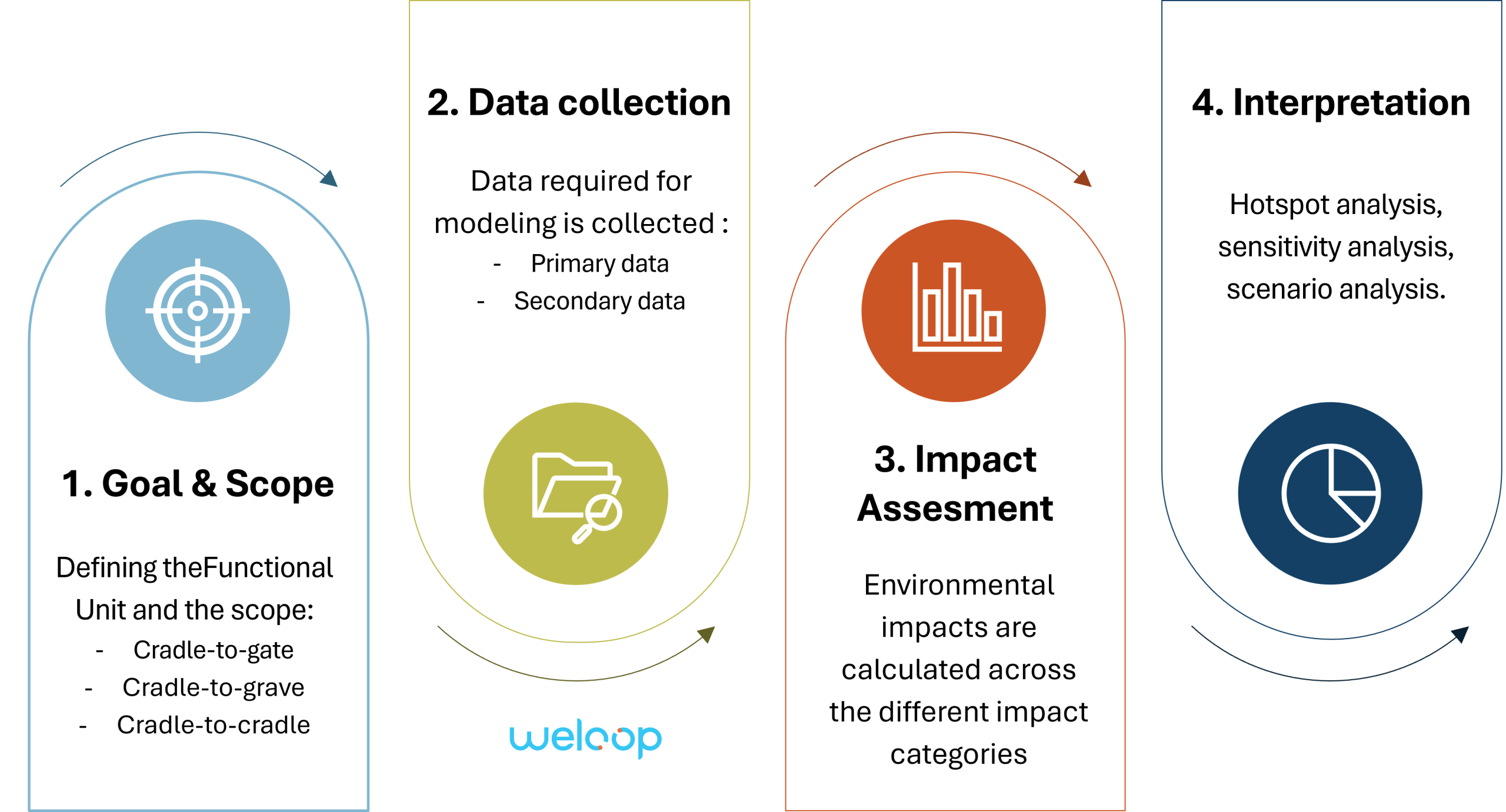
A life cycle assessment study is structured into four distinct phases, defined by the ISO 14040/14044 standards. The process is iterative: each phase can inform and refine the previous ones, until the results meet the set objectives.
1. Goal & scope definition
In this first step, the study's objectives are defined, and the functional unit is established:
For batteries, the functional unit the functional unit can be defined as energy storage over a given number of cycles under specified conditions, for example "the storage of 1 kWh over 1,000 cycles".
In the Draft Delegated Act of the EU Battery Regulation, the F.U. is defined as «the total energy delivered over the battery's lifetime».
It is also at this stage that the scope of the study is defined:
– Cradle-to-grate: from raw material extraction to the end of production.
– Cradle-to-grave: from raw material extraction to landfill or incineration at the end of life
– Cradle-to-cradle:erceau with recycling and reintegration of recovered materials
2. Data collection:
Life Cycle Inventories (LCIs)
The next step is to collect all the data required for the modelling. This data falls into two categories:
La representativeness of secondary data can be improved based on knowledge of the specific supply chains and dataset availability.
3. Impact assessment
Once the data has been collected and the model built, the environmental impacts for the different impact categories are calculated using recognised characterisation methods.
This method covers 16 impact categories, including climate change, resource use (mineral or fossil), water use, and human toxicity (carcinogenic and non-carcinogenic).
LCA's multi-criteria approach LCA’s multi-criteria approach is essential to avoid impact transfer. A battery may have a competitive carbon footprint while still generating significant impacts in areas such as water consumption or toxicity.
4. Result interpretation
The results are analysed in light of the initial objectives:
Results and hotspots can be obtained for the entire lifecycle, by lifecycle stage, or by input type.
It is at this stage that LCA becomes a decision-making tool.
Who is involved in data collection for battery LCA?
In a complex value chain, data collection for a comprehensive LCA could not be carried out independently. The robustness of the study directly depends on the data quality at each stage of the life cycle, and therefore on the capacity to engage the associated stakeholders.
Life Cycle Stage
Stakeholders
Factors influencing LCA
Major challenge
Extraction and refining
of raw materials
Suppliers (mine operators, refineries, producers)
Mine location, refining technology
Traceability, the complexity of the value chain
Production
Cell and pack manufacturers,
energy providers
Energy mix, manufacturing technology, chemistry, yield and losses
The confidentiality of
industrial data
Distribution
Transport operators to the point of sale
Point of sale localisation and type of transport
Data dispersion and granularity
Usage
Product R&D teams,
clients and users
Battery specifications, energy mix, charging mode
Modelling real-world use case scenarios
Second life and
End of Life
Collection operators, second-life operators, and recyclers
Integration of a second life, recycling technology
The immaturity of the supply chains, the uncertainty over the real collection rates
Our support for battery LCA
Carrying out a rigorous battery LCA requires technical and methodological expertise, representative data, and knowledge of the sector's specificities. Since 2019, BATTERS by WeLOOP has been supporting industrial players with these challenges, for both the production and end-of-life stages of batteries.
At BATTERS, we support manufacturers in implementing
la rigorous and actionable LCAs, rigoureuses et exploitables,
in advancing their eco-design initiatives,
and in conducting criticality assessments,
to help drive environmental strategy, meet regulatory requirements, and enhance product value in increasingly demanding markets.
Thanks to our BATTERS platform, currently under development as part of the BATTERS Phase 2 project, we will also be able to support you with the primary data collection necessary throughout your value chain for carrying out reliable, regulatory, and representative LCAs.